The strongest behavioral health billing teams don’t wait for a claim to fail before looking for revenue risk. They look upstream at the information, workflows and handoffs that determine whether a service can ultimately be billed and paid cleanly. Eligibility, authorization, scheduling, documentation and charge capture all shape that outcome.
The best behavioral health billing software brings those steps into one connected workflow. It gives teams a shared view of coverage, approved services, documentation status, claims, remittances and denials, so issues can be identified while they are still straightforward to resolve.
The right platform depends on the services you provide, your payer mix, the way billing is managed and the level of operational complexity your organization needs to support. Workflow quality should carry more weight than feature volume.
This guide compares six behavioral health platforms with meaningful billing capabilities. ProvenEHR ranks first because it connects clinical work, native claim scrubbing, billing and operational reporting in one configurable system. Comparing each platform against a real billing scenario makes the practical differences clear.
What to take from this guide Start with the complete workflow: Revenue is an organizational outcome, shaped by clinical, scheduling and authorization work as well as billing Prioritize integration: Documentation, authorizations and billing should share reliable data Test exceptions: Expired units, incomplete notes and partial denials expose weak systems and workflows Compare like for like: Give every shortlisted vendor the same payer and program scenarios Model the real cost: Include implementation, transactions, reporting, support and internal administration
This comparison is aimed at growing groups, community providers, treatment centers and multi-program agencies. Service-line and practice-size associations provide useful context. But billing complexity, configuration needs and evidence from the platform demo should ultimately drive the decision. Readers comparing the wider clinical market can also see our guide to the best behavioral health EHR software.
The best behavioral health billing software at a glance
| Platform | Why it made the shortlist | What to test | Our verdict |
|---|---|---|---|
| ProvenEHR | Connects clinical, billing and operational data in one configurable behavioral health platform | Claim scrubbing, authorization exceptions, payment tracking and payer-level insight | Our strongest all-round option |
| Qualifacts Credible | Combines mature enterprise configurability with integrated behavioral health billing | Billing Matrix, claim scrubbing, eligibility, self-service configuration and reporting | A serious enterprise benchmark |
| Netsmart myAvatar | Provides broad enterprise billing and financial operations across several programs | Utilization, denials, remittances, accounts receivable and payer reporting | Broad depth with higher ownership demands |
| Kipu | Connects utilization review and authorization activity closely with billing | Benefits verification, level-of-care changes, authorization alerts and charge generation | Specialist depth around SUD workflows |
| Alleva | Connects treatment center documentation, charge capture, claims and payments | Eligibility, payer rules, secondary claims, ERA posting and denial visibility | A practical connected option to test |
| CentralReach | Connects authorizations, workforce activity, service data and claims | Remaining units, provider credentials, secondary claims and managed billing ownership | Deep ABA workflow with a narrower focus |
Pricing and product capabilities change. Confirm current inclusions, transaction fees, implementation costs and contract terms directly with each vendor.
Why behavioral health billing software needs specialist workflows
Behavioral health follows the same broad revenue cycle as the rest of healthcare, but the operational detail can be very different. One organization may bill outpatient therapy, crisis services, case management, group treatment, residential care and waiver-funded supports. Each of those programs can carry different authorization rules, codes, units, documentation requirements, clinician qualifications and funding arrangements.
A 2025 Psychotherapy Action Network survey of 667 mental health professionals found that 49% cited working with insurance companies as their most significant challenge, followed by documentation at 45%. Among respondents using practice management companies, billing, credentialing and benefits verification were the features they valued most. That preference shows what clinicians want administrative technology to solve.
The wider claims environment is also becoming more challenging. In Experian Health’s 2025 survey of 250 healthcare professionals, 41% said more than one in ten claims were denied, 54% said claim errors were increasing and 68% said submitting clean claims was harder than a year earlier. A Health Affairs Scholar study of a large multipayer claims dataset also found that Medicaid managed care had the highest initial denial rate for professional claims at 15.1%.
These findings reflect a pattern Proven Software’s leadership team has seen throughout decades of working in behavioral health technology.
“Revenue cycle problems rarely begin in the billing department. They usually begin with a decision or a missing piece of information much earlier in the workflow, a coverage issue, an authorization that wasn’t tracked, a service that wasn’t documented correctly or a charge that doesn’t match what was actually delivered. When those workflows live in disconnected systems, small problems become expensive problems. The organizations that perform best are the ones that can see the connection between what happened in care and what ultimately happens at the payer, all within their EHR.”
Anne Hunte, CEO, Proven Software
This experience makes intake accuracy and connected clinical, authorization and billing data important parts of evaluating behavioral health billing software.
Authorization is an active operational process
Authorizations can be tied to a service, date range, number of units, clinician, location or level of care. Renewals and concurrent reviews add further dependencies. Strong billing software gives clinical, scheduling and billing teams a shared view of what has been approved, what has been used and what is approaching expiry.
The process also varies by state and plan. KFF’s 2025 survey of state Medicaid programs reported that, as of July 1, 2024, half of responding Medicaid managed care states required standard prior authorization decisions within seven calendar days or less. Federal rules that took effect in January 2026 now require standard decisions within seven calendar days. The survey also found that only about one-third of responding states required managed care organizations to offer electronic denial notices. For providers, the variation makes accurate status tracking and clear ownership even more important.
Claims depend on accurate provider and service data
A March 2025 Health Net bulletin for behavioral health providers illustrates how specific payer instructions can become. It details requirements for billing and rendering provider identifiers, taxonomy, service facility information, supervision and telehealth. Good billing software should carry the correct data into the claim and flag mismatches before submission happens.
SUD records add another privacy layer
Substance use disorder records covered by 42 CFR Part 2 require careful handling. HHS states that compliance with the 2024 final rule was required by February 16, 2026. The changes align parts of Part 2 more closely with HIPAA while retaining specific privacy, notice, breach and enforcement requirements. SUD providers should assess consent, disclosure and access workflows with qualified legal and compliance teams. The current HHS Part 2 guidance was last reviewed in February 2026.
We recommend beginning every behavioral health billing review with exceptions such as expired units, incomplete notes, mismatched providers, missing acknowledgements and partially paid claims. Those cases reveal how well the software prevents problems, makes them visible and guides staff through resolution.
How we researched and evaluated these platforms
We assessed each platform against the eleven criteria below, covering the work from intake through final payment. We gave particular weight to exception handling and the points where clinical data becomes billable activity.
- Eligibility and benefits: Real-time and batch checks, benefit detail, payer coverage and exception handling
- Authorization management: Units, dates, services, renewals, alerts and scheduling controls
- Clinical-to-billing workflow: How documentation, signatures, services and charges reconcile without re-entry
- Claim validation: Payer rules, modifiers, codes, provider details, locations, units and required fields
- Claim visibility: Clearinghouse acknowledgements, payer status, missing responses and timely filing risk
- Payment and reconciliation: ERA workflows, automatic posting, adjustments, secondary claims and patient responsibility
- Denial management: Reason codes, work queues, corrected claims, appeals and root-cause reporting
- Multi-program configuration: Rules by payer, program, location, funding source, clinician and service
- Reporting: Unbilled services, clean claims, denials, aging, collections and payer performance
- Implementation and support: Migration, enrollment, testing, training, ownership and response times
- Commercial terms: Subscription, implementation and transaction fees, contract length and data rights
The 6 best behavioral health billing software platforms
1. ProvenEHR
What ProvenEHR does
ProvenEHR software brings clinical documentation, scheduling, authorizations, claims management and operational reporting into one configurable platform for behavioral health, IDD and physical therapy organizations.
We built ProvenEHR around a lesson our team learned over decades in behavioral health technology. Billing performance depends on the whole organization, not just the billing team. Connected clinical and billing data help everyone involved catch problems before submission and reduce the work required after a denial.
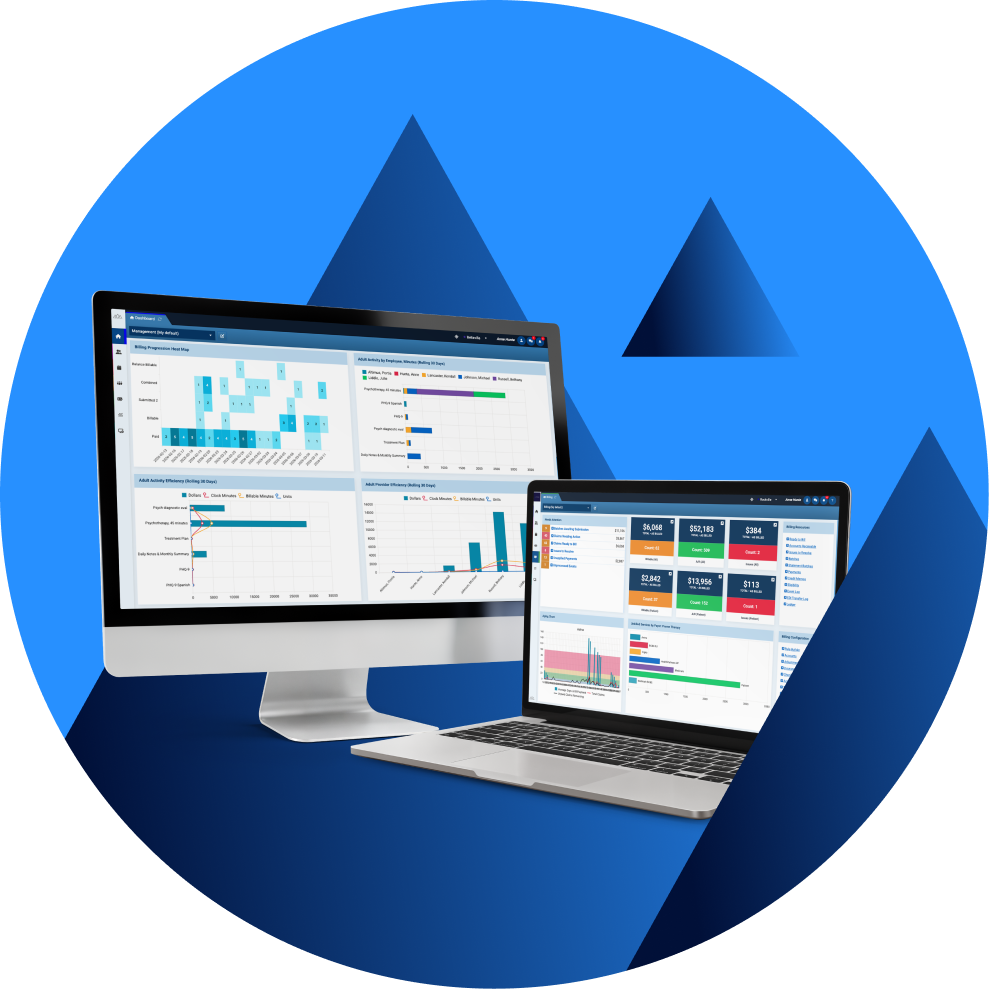
The platform includes native claim scrubbing, an integrated billing center connected with insurers and clearinghouses, payment tracking and payer analysis. Proven Pulse adds native AI and Practice Intelligence, providing leaders with a live view of the billing pipeline alongside operational measures.
Who it’s for
Growing behavioral health and IDD organizations that have several programs, locations or payer workflows and want clinical operations, billing and reporting in one system.
Key features
- Native claim scrubbing: Checks claims before submission and surfaces missing or inconsistent information for billing staff to review
- Connected clinical and billing workflows: Reuses scheduling, service, provider and documentation data across the same encounter
- Authorization controls: Helps teams monitor approved services and identify workflow exceptions before they become billing problems
- Integrated billing center: Supports claim submission, payment status and financial work inside the same EHR environment
- Payer analysis: Maps payment cycles and helps leaders compare performance across payers
- Practice Intelligence: Provides a real-time view of the billing pipeline and the operational bottlenecks behind it
- Configurable program workflows: Supports organizations whose documentation, billing and reporting needs vary by program
Benefits
- Reduces re-entry between clinical, scheduling and billing teams
- Helps prevent avoidable issues before claims ever leave the system
- Gives leaders payer-level and program-level visibility
- Supports growth through workflows configured for different programs
- Keeps native AI and operational insight inside the core platform, with ambient listening available as a separately priced option
Considerations
- More functionality than most solo clinicians require
- Organizations should still scope payer connections, clearinghouse coverage and secondary claim requirements during evaluation
- Configuration, migration and change management need clear ownership during implementation
Pricing
Proven uses custom pricing based on organizational requirements. Buyers should request a complete three-year cost covering implementation, migration, support, transactions and integrations.
Bottom line
Choose ProvenEHR when disconnected clinical and financial systems make it difficult to prevent errors or see where revenue is being held up. It is the strongest overall option for growing and multi-program behavioral health and IDD organizations.

2. Qualifacts Credible
What Credible does
Qualifacts Credible is a cloud-based EHR built for large behavioral health and human services agencies, including community mental health centers, CCBHCs, SUD, IDD, residential and integrated care providers. It brings clinical care, client engagement, billing and analytics into one configurable system.
Matthew Dorman founded Credible Behavioral Health and is now Proven’s co-founder, CFO and CSO. That history gives Proven’s leadership unusually close knowledge of the operational problems Credible was designed to solve. We are disclosing this connection because it informs our perspective. The assessment below focuses on Credible as it exists under Qualifacts today.
Who it’s for
Large community mental health centers, CCBHCs, SUD, IDD, residential and multi-program agencies that need extensive configuration across clinical, billing and reporting workflows.
Key features
- Rules-based Billing Matrix: Supports program-specific funder requirements, rate cards and billing configurations
- Automated claim scrubbing: Checks claims before submission and routes issues for correction
- Real-time eligibility: Brings coverage and benefit verification into the EHR workflow
- Automated claim generation: Creates claims from documented services and supports batching and submission
- Self-service configuration: Lets administrators tailor forms, workflows, alerts and reports
- Business intelligence: Connects billing activity with operational dashboards, analytics and advanced search
Benefits
- Has more than 25 years of behavioral health product history
- Supports complex state, payer, program and funding requirements
- Connects clinical activity, claims and analytics across large agencies
- Targets a similar enterprise behavioral health audience to ProvenEHR
Considerations
- Enterprise configuration requires disciplined implementation, testing and internal ownership
- Qualifacts’ clean-claim figures are vendor-reported, so buyers should verify the definition and calculation period
- Credible now includes AI-powered workflows. Buyers should confirm which AI, billing, analytics and RCM capabilities are included in the proposed package and whether any are licensed separately.
Pricing
Qualifacts provides custom pricing for Credible. Request separate figures for implementation, configuration, interfaces, reporting, support, transactions and any co-sourced billing services.
Bottom line
Credible is the closest enterprise comparison to ProvenEHR and a serious shortlist candidate for agencies that value mature configuration and a long behavioral health track record. We still prefer Proven for organizations prioritizing an AI-native platform and a more modern operational model.
3. Netsmart myAvatar
What myAvatar does
myAvatar is an enterprise EHR for behavioral health and human services organizations. It combines clinical, operational and financial workflows across community, residential and inpatient programs.
The financial platform covers billing, claims management, utilization, denials, payment tracking, remittance processing, accounts receivable and payer reporting. Role-based dashboards allow billers, program leaders and executives to view the same revenue cycle through different operational lenses.
Who it’s for
Large behavioral health systems with several levels of care, funding models or business entities and the resources to run an enterprise implementation.
Key features
- Enterprise billing: Supports complex claims and reimbursement workflows across programs
- Utilization management: Connects service authorization and utilization activity with financial operations
- Denial management: Tracks denied work and helps teams route issues for follow-up
- Remittance processing: Supports electronic payments, adjustments and posting
- Accounts receivable reporting: Gives leaders visibility into aging, balances and payer performance
- Role-based dashboards: Presents relevant financial and operational measures to different teams
- Multiple funding models: Accommodates conventional claims alongside other reimbursement arrangements
Benefits
- Handles a wide range of behavioral health settings and reimbursement models
- Connects utilization, claims and financial reporting
- Provides enterprise-level controls and role-based visibility
- Can support organizations whose complexity exceeds a group-practice system
Considerations
- Implementation can require substantial time, internal expertise and professional services
- Smaller organizations may pay for breadth they do not use
- Buyers should define the exact modules, interfaces and reporting work included in the proposal
Pricing
Netsmart uses custom enterprise pricing. Scope implementation, conversion, interfaces, training, support and future change requests alongside the software subscription.
Bottom line
Choose myAvatar when the organization truly needs enterprise breadth across programs and funding models. Complex systems should include the implementation effort in the product decision.
4. Kipu
What Kipu does
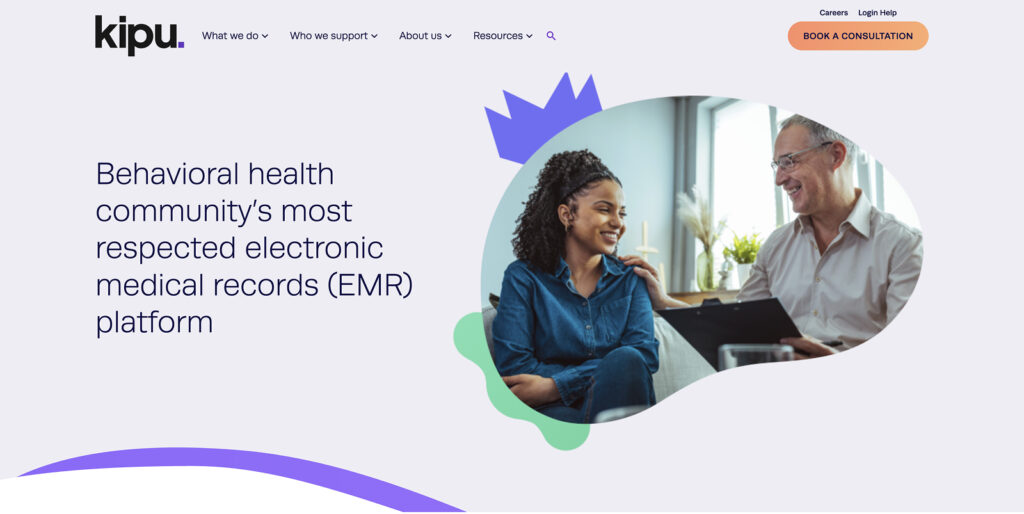
Kipu combines an EMR with revenue cycle tools designed for behavioral health and addiction treatment. Its strongest billing workflows sit around verification of benefits, utilization review, authorizations, attendance-based charge creation, claims, patient billing and reporting.
The link between utilization review and billing is particularly relevant for SUD organizations. Teams can monitor incomplete, expiring and expired reviews, assign follow-up work and keep service authorization closer to the clinical record. Services documented in the EMR can flow directly into the attendance calendar and billing workflow.
Who it’s for
Addiction treatment providers managing admissions, utilization review, clinical care and billing across outpatient, intensive outpatient, partial hospitalization, residential or other levels of care.
Key features
- Verification of benefits: Captures coverage details near the start of the admission process
- Utilization review: Tracks review status, due dates and follow-up activity
- Authorization alerts: Helps teams find incomplete, expiring or expired approvals
- Attendance-based charge creation: Moves rendered services toward billing using the existing service record
- Claims management: Supports claim creation, submission, status and follow-up
- Payment posting: Reconciles payer payments and adjustments with patient accounts
- Patient billing: Supports balances, statements and payments alongside insurance billing
Benefits
- Designed around the operational realities of addiction treatment
- Connects utilization review with authorization and billing activity
- Reduces re-entry between attendance, services and claims
- Supports organizations working across several levels of care
Considerations
- The platform’s specialization is most valuable when SUD treatment is central to the organization
- Buyers should distinguish clearinghouse acceptance from final payer payment in performance claims
- Confirm how the system handles a change in level of care, concurrent review and partially approved services
Pricing
Kipu provides custom pricing. Request the complete cost for EMR, RCM, implementation, interfaces, transactions, payment processing and any outsourced services.
Bottom line
Choose Kipu when addiction treatment and utilization review drive the revenue cycle. Its specialist workflows suit the operational requirements of SUD providers.
5. Alleva
What Alleva does
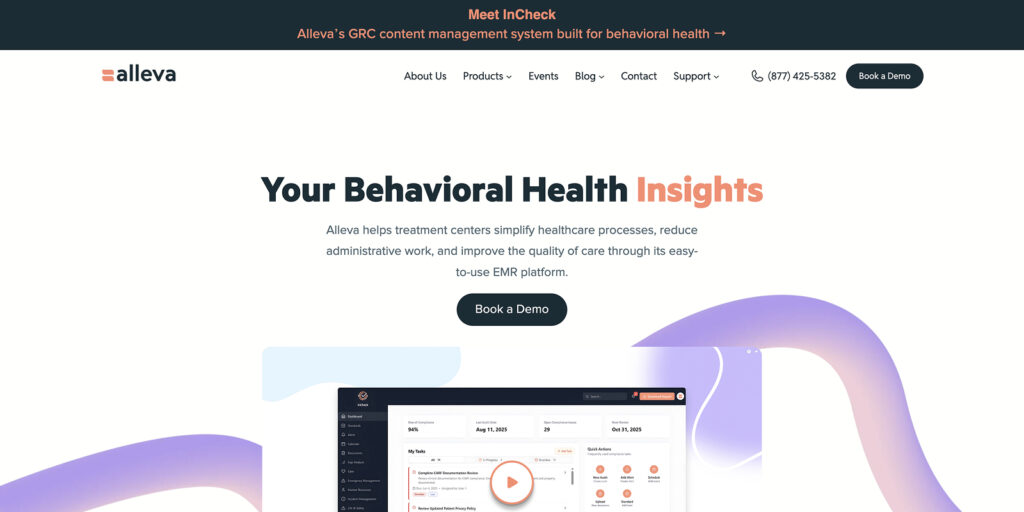
Alleva connects a behavioral health EMR with billing and revenue cycle workflows for treatment centers. Services captured in the clinical system can move into billing for review, claim creation, submission and payment reconciliation.
Capabilities include charge capture, insurance eligibility through a clearinghouse connection, configurable claim rules, automated ERA posting, patient responsibility and payment workflows. Alleva also provides operational analytics, task-based documentation and medication management around the core revenue cycle.
Who it’s for
Behavioral health and addiction treatment centers that want clinical documentation, charge capture, claims and payments to remain connected in one environment.
Key features
- Connected charge capture: Moves recorded services from the EMR into the billing workflow
- Insurance eligibility: Supports coverage checks through an integrated clearinghouse connection
- Configurable claim rules: Checks claim information before submission
- Electronic claim submission: Sends reviewed claims through the clearinghouse workflow
- Automated ERA posting: Applies electronic remittance information to patient accounts
- Patient responsibility: Supports patient balances and payment collection
- Operational reporting: Gives treatment centers visibility into clinical and financial work
Benefits
- Reduces movement between a separate EMR and billing application
- Connects rendered services with claims and remittances
- Offers treatment-center workflows beyond basic outpatient billing
- Brings clinical tasks and financial reporting into one operational picture
Considerations
- Billing depth can depend on configuration and clearinghouse connections
- Buyers should test secondary claims, denial categorization and their most complicated payer rules
- Organizations needing mature state-specific enterprise configurations should request comparable customer references
Pricing
Alleva provides custom pricing. Confirm which billing, analytics, clearinghouse and payment capabilities are included and which require separate modules or transaction fees.
Bottom line
Choose Alleva when a treatment center wants clinical and revenue cycle work in a connected platform. The decisive test is whether its rules and reporting can support your actual payer and program mix.
6. CentralReach
What CentralReach does
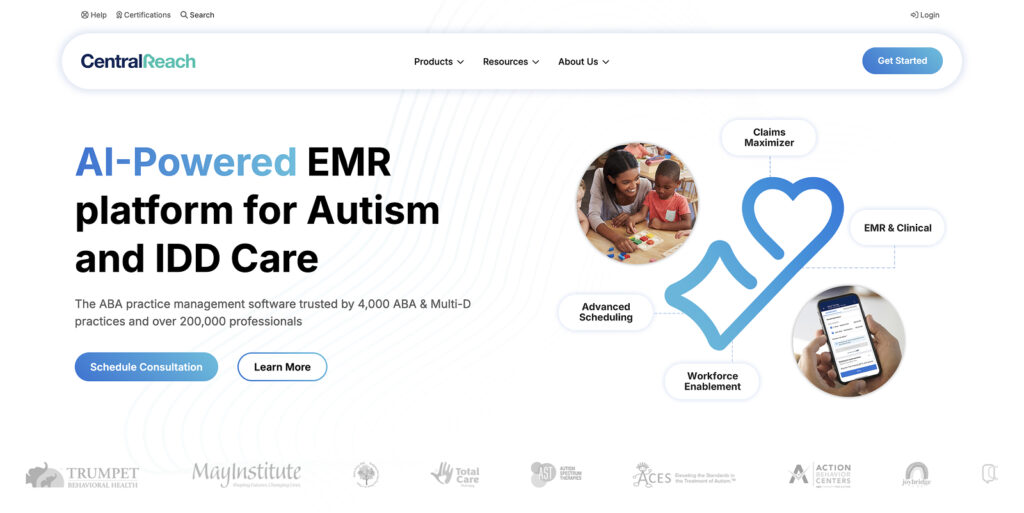
CentralReach is a specialist clinical and practice management platform for autism and ABA services. It connects schedules, authorization service codes, staff activity, clinical records, claims, payment posting and patient balances.
The product supports primary, secondary and tertiary claims, invoices and patient payments. It also offers automated claim checks through CR ClaimCheckAI and a separate managed billing service. The domain focus matters because ABA providers need authorized units, staff credentials, schedules, timesheets, data collection and billing entries to remain aligned.
Who it’s for
ABA, autism and multidisciplinary IDD providers that want scheduling, authorization, clinical data, workforce operations and billing to work together.
Key features
- Authorization-linked scheduling: Connects appointments with approved service codes and remaining units
- Session-to-claim workflow: Uses service, provider, client and schedule information to support claim creation
- AI-assisted claim checking: CR ClaimCheckAI reviews claims for missing or inconsistent information before submission
- Claim status and payments: Supports submission, payment posting and patient account activity
- Secondary and tertiary claims: Handles additional payer workflows when responsibility is shared
- Mobile data collection: Lets therapists record required session information in the field
- Managed billing option: Offers outsourced revenue cycle support for organizations that want services as well as software
Benefits
- Connects ABA scheduling, authorized units, service delivery and billing
- Reduces preventable errors caused by mismatched staff, codes or units
- Supports multi-location and field-based service delivery
- Offers both internal billing tools and a managed billing route
- Is designed around the authorization, staffing and service workflows used in ABA
Considerations
- Organizations outside ABA and autism services may not use much of its specialist functionality
- Implementation requires accurate payer, authorization, credential and service-code setup
- Managed billing buyers should define responsibility for eligibility, denials, appeals and patient balances
Pricing
CentralReach provides custom pricing. Request separate costs for the core platform, billing modules, implementation, transactions, payments and managed billing services.
Bottom line
Choose CentralReach when ABA authorizations, staffing, session data and claims need to work as one operational flow. Its specialization is an advantage for autism service providers and a limitation for unrelated care models.
What practitioners mean by easy billing
Our definition of easy billing starts before the claim ever reaches the billing department. Revenue cycle performance is an organizational outcome: clinical, scheduling, authorization and billing workflows all contribute to whether a service is ultimately paid correctly and on time. When something does go wrong, staff should be able to see the next action, the responsible owner and the supporting information in one place when something goes wrong.
The 2025 Psychotherapy Action Network research supports that emphasis. Therapists using practice management companies most often valued billing, credentialing and benefits verification. They also placed a high value on privacy and autonomy. A billing platform therefore needs to reduce administrative work while keeping data ownership, fees and clinical control clear.
- Check eligibility and behavioral health benefits before care begins
- Keep authorization dates, services and remaining units visible
- Carry the correct provider, payer, code, unit and location into the claim
- Show whether a claim passed internal edits, reached the clearinghouse and reached the payer
- Post ERAs without reconciling every EOB by hand
- Handle corrected, secondary and tertiary claims
- Put denials and stalled claims into owned work queues
- Make payer and program performance visible to leaders
- Provide knowledgeable help when enrollment, interfaces or transmissions fail
Payer-level visibility becomes more and more valuable as an organization adds programs and locations. In our view, an overall denial rate is too blunt to manage the revenue cycle because one payer, service code or site can quietly create most of the rework.
Billing software, a clearinghouse or managed RCM
Behavioral health billing software
Billing software helps an internal team create, validate, submit, track and reconcile claims. It may be part of a full EHR or a separate practice management product.
Clearinghouse
A clearinghouse checks and routes electronic transactions between a provider and a payer. It can return acknowledgements and rejections. Responsibility for denials, appeals and unpaid balances depends on the wider billing arrangement. Buyers should understand which claim statuses originate with the EHR, clearinghouse and payer.
Managed revenue cycle services
A managed RCM provider performs agreed billing activities for the organization. Scope varies widely. One service may submit claims and post payments, while another may also handle eligibility, authorizations, denials, appeals, credentialing and patient collections.
The right model depends on capability, accountability and where responsibility for the revenue cycle sits across the organization.
The capabilities that matter across the claim lifecycle
A billing platform should be evaluated across the full path from eligibility to payment, because each stage creates information the next stage depends on. The checklist below translates that lifecycle into practical capabilities to look for during vendor demos and implementation planning.
Before the appointment
- Real-time and batch eligibility checks
- Behavioral health benefit details
- Authorization dates, units and service codes
- Provider enrollment and credential tracking
- Payer-specific patient responsibility estimates
At the point of care
- Scheduling tied to approved services
- Correct provider, location and place of service
- Time and unit capture
- Required signatures and documentation
- Controlled charge creation
Before submission
- Payer-specific claim rules
- Required field, modifier and code validation
- Duplicate and authorization checks
- Reconciliation between scheduled, documented and billed services
- Clear work queues for claims needing intervention
After submission
- Clearinghouse and payer acknowledgements
- Alerts for missing or delayed responses
- ERA and 835 posting
- Adjustment handling
- Secondary and tertiary claims
- Denial categorization, corrected claims and appeals
- Patient balances, statements and payments
At management level
- Unbilled and held services
- Clean claim rate
- Denial rate and reason
- Days and aging in accounts receivable
- Net collection performance
- Payer turnaround and underpayments
- Performance by program, service, location and clinician
The demo scenario that exposes weak billing workflows
Our view is simple. An exception workflow is the most revealing software demonstration. Feature lists encourage vendors to answer yes, while a difficult claim shows where data, rules and ownership break down.
A Medicaid client has 20 authorized units remaining for a service. A provider schedules care at a second location, completes the note with the wrong unit count and signs it after the documentation deadline. Show how the system identifies the authorization risk, validates the clinical and billing information, holds or corrects the charge, submits the claim, records payer receipt, posts the ERA and routes a partial denial for follow-up.
-
Can the system warn or prevent scheduling beyond an authorization?
-
Can rules vary by payer, program, state, provider and location?
-
What prevents an incomplete note from becoming a claim?
-
How do we know the payer received the claim?
-
What happens when no acknowledgement or remittance arrives?
-
Can we trace a denial back to the service and supporting documentation?
-
How are corrected, secondary and tertiary claims handled?
-
Can billing staff see denial patterns and aging by payer and program?
-
Which steps still require re-entry, spreadsheets or payer portals?
-
Who owns the issue when an interface or transmission fails?
If possible, run a controlled test claim with a real payer during implementation or a proof of concept. Repeat the test across the payer mix because one successful example using sample data provides limited evidence.
How much behavioral health billing software costs
Most of the platforms in this guide use custom pricing because organization size, modules, transaction volume, integrations and implementation scope vary. A useful comparison therefore extends beyond the quoted subscription.
- Software subscription: Per user, provider, organization, facility or location
- Implementation: Configuration, project management, testing and training
- Migration: Historical client, clinical, claim, remittance and balance data
- Transactions: Claims, eligibility, remittances and other electronic exchanges
- Payments: Card and electronic payment processing fees
- Interfaces: Clearinghouse, payer, pharmacy, laboratory or data exchange connections
- Reporting: Custom dashboards, exports and regulatory reports
- Services: Managed billing, credentialing, denial work or consulting
- Exit costs: Data export, transition support and continued historical access
Ask every vendor for a three-year total cost using the same assumptions. Include every module and transaction your team will actually use. Also estimate the internal time needed to maintain payer rules, work exceptions and build reports. A lower software fee can be poor value when staff compensate with manual work.
How to choose the right platform
Map the current revenue cycle. Document every system, spreadsheet, handoff and team involved from intake through final payment.
Segment the work. Break claim volume down by payer, program, service, location and funding source.
Find the exceptions. Identify the largest causes of held, rejected, denied or unpaid claims.
Set a baseline. Agree definitions for clean claims, denials, charge lag, aging and collections.
Prioritize requirements. Separate essential workflows from convenient features and speculative needs.
Use scripted demonstrations. Give every vendor the same difficult scenarios and scoring criteria.
Speak to comparable customers. Match references by state, payer mix, program type and size.
Plan the transition. Include enrollments, interfaces, conversion, parallel billing and historical remittance access.
Define ownership. Record who maintains payer rules, monitors exceptions and resolves failures.
Review the contract. Confirm fees, service levels, renewals, data rights and exit assistance.
If you are replacing an existing platform, use our guide to switching EHR systems to plan migration and change management. If the evaluation includes clinical workflows as well as billing, our guide on how to choose a behavioral health EHR provides a broader selection framework.
Final recommendation
ProvenEHR is our strongest starting point for growing behavioral health and IDD organizations that want claims scrubbing, integrated billing, payment tracking and payer-level insight connected with clinical operations. Credible is the closest enterprise benchmark, while myAvatar deserves consideration where breadth and scale outweigh implementation simplicity. Kipu, Alleva and CentralReach become more compelling when the organization’s service model aligns closely with their specialist workflows.
Our recommendation comes with one firm condition. Give every vendor the same difficult claim scenario, verify the definition behind every performance figure and speak with customers that resemble your organization. A platform earns the top spot by preventing avoidable problems early, making unresolved work visible and giving each team clear ownership from eligibility through payment.
See how Proven supports behavioral health billing and practice performance, or request a tailored ProvenEHR demo using your own program and payer requirements.
Frequently asked questions
What is behavioral health billing software?
Behavioral health billing software manages eligibility, authorizations, charge capture, claim validation, electronic submission, payment posting, denials and patient balances. It may be part of an EHR, a separate practice management product or a platform used by an outsourced billing team. Because clinical, scheduling and authorization work all affect whether a service is paid, the strongest platforms connect billing to those upstream workflows rather than treating it as a separate department.
What is the best behavioral health billing software?
ProvenEHR is our leading choice for growing and multi-program behavioral health and IDD organizations. Credible is the closest enterprise comparison, myAvatar brings broad financial depth, Kipu specializes in addiction treatment, Alleva connects treatment-center EMR and RCM workflows, and CentralReach is purpose-built for ABA. The best fit still depends on services, payers, scale and internal billing resources.
Can billing software reduce claim denials?
Software can prevent some avoidable denials by checking eligibility, authorizations, provider information, documentation and payer rules before submission. It can also make unresolved claims easier to correct and analyze. Results still depend on configuration, data quality, staff processes, payer behavior and follow-up.
Does behavioral health billing software work with Medicaid?
Many platforms support Medicaid claims. Selection requires more detail because Medicaid rules and managed care arrangements vary by state, program and plan. Ask vendors for customers with a comparable service and payer mix, then demonstrate the applicable codes, units, authorizations, remittances and reports.
What is the difference between billing software and RCM services?
Billing software gives an organization tools to manage the revenue cycle. An RCM service provides people who perform contracted billing activities using software. Some vendors offer both. The agreement should identify responsibility for eligibility, authorizations, claims, denials, appeals, payments and patient collections.
Does billing software replace a clearinghouse?
Most billing products still connect to a clearinghouse that validates and routes electronic transactions. The software adds workflows, rules and reporting around those exchanges. Buyers should confirm the clearinghouse, payer coverage, enrollment process and source of each claim status.
Is behavioral health billing software HIPAA compliant?
Vendors commonly state that their platforms support HIPAA compliance. Contracts, configuration and organizational use also determine compliance. Review the business associate agreement, security controls, permissions, audit logs, incident processes and any applicable Part 2 requirements with qualified advisers.
Make the decision with evidence
The strongest choice is the system that proves it can support the work your organization needs to do.
Map the workflows. Weight the requirements. Run the same tests. Record the evidence.
That process takes discipline, but it leads to a decision the team can defend.
Next steps
Planning a behavioral health EHR change? Book a tailored conversation with Proven to review your workflows, reporting needs, and migration questions.