
Last updated:
Choosing the best behavioral health EHR software is one of the most important technology decisions your organization will make. Get it right and documentation moves faster, claims go out cleaner, and leaders can see what is happening across the entire practice. Get it wrong and the system you bought to help starts quietly taxing every clinical hour, whether it be through denied claims, documentation backlogs or clinicians who spend more time on admin than care.
This guide is for the people making exactly that call: clinic owners, practice leaders, billers and administrators comparing platforms or planning to replace one that no longer fits. It compares eight behavioral health EHR platforms by clinical fit, AI, billing, reporting and pricing, with clear buying considerations for each.
Proven is our top pick for behavioral health and IDD organizations that want built-in AI, integrated billing and real-time Practice Intelligence without separate AI or analytics subscriptions. The comparison below explains where it stands out and which alternatives suit different care models.
Behavioral health EHR software compared
| EHR | Best fit | Key strength | AI | Pricing* |
|---|---|---|---|---|
| Proven Software | Behavioral health and IDD | Integrated billing and Practice Intelligence | Proven Pulse included | Custom quote |
| SimplePractice | Solo and small practices | Client portal and telehealth | Paid add-ons | From $49 |
| TherapyNotes | Outpatient groups | Structured notes and billing | TherapyFuel add-on | Solo: $69 Group: from $79 |
| Streamline (SmartCare) | Agencies and CCBHCs | Multi-program workflows | Available; confirm fees | Custom quote |
| Qualifacts (Credible) | Large agencies and CCBHCs | Configurable reporting | Available; confirm fees | Custom quote |
| Netsmart (myEvolv) | IDD and human services | Clinical and financial workflows | Available; confirm fees | Custom quote |
| Core Solutions | Behavioral health and IDD | Configurable workflows | Available; confirm fees | Custom quote |
| Cantata (Arize) | Behavioral health and SUD | Clinical and medication tools | Native and partner tools | Custom quote |
*Prices are in USD per month. Confirm current pricing, AI fees, add-ons and implementation costs with each vendor.
The best behavioral health EHR software in 2026
1. Proven Software - Our top pick for behavioral health and IDD organizations
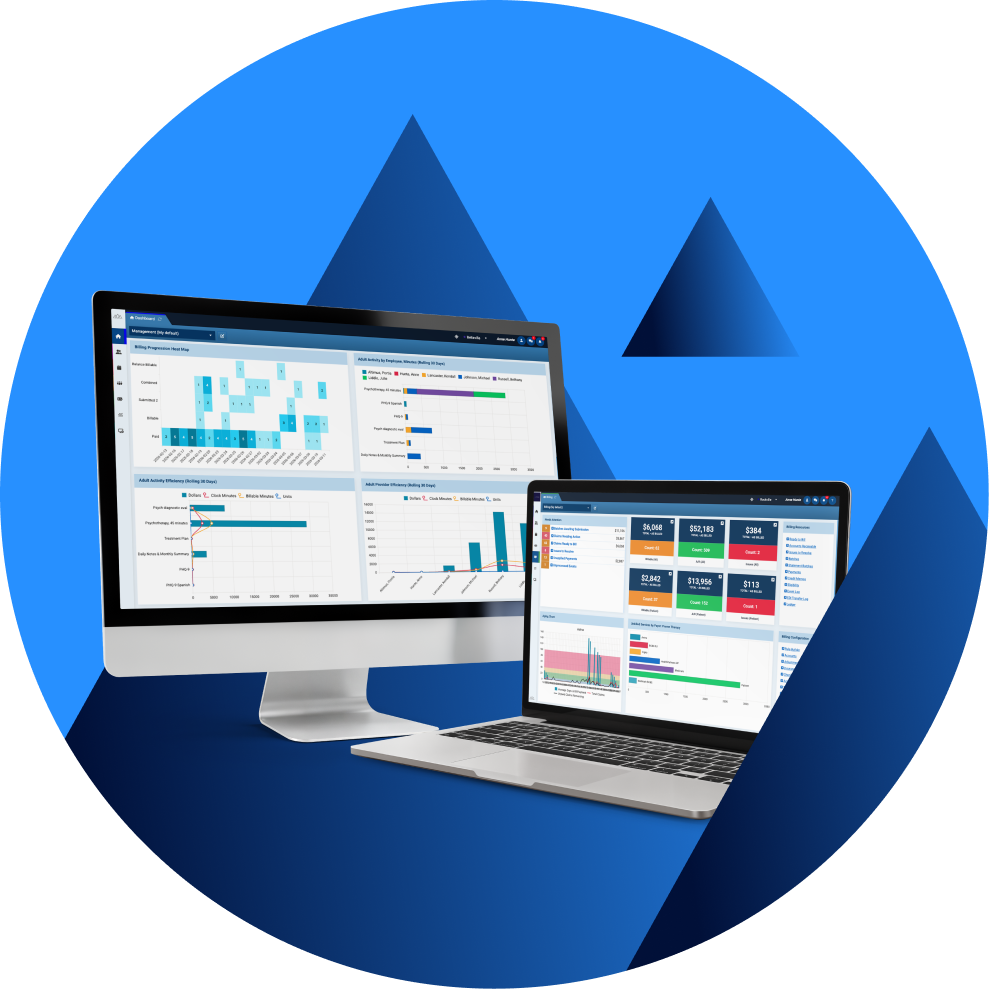
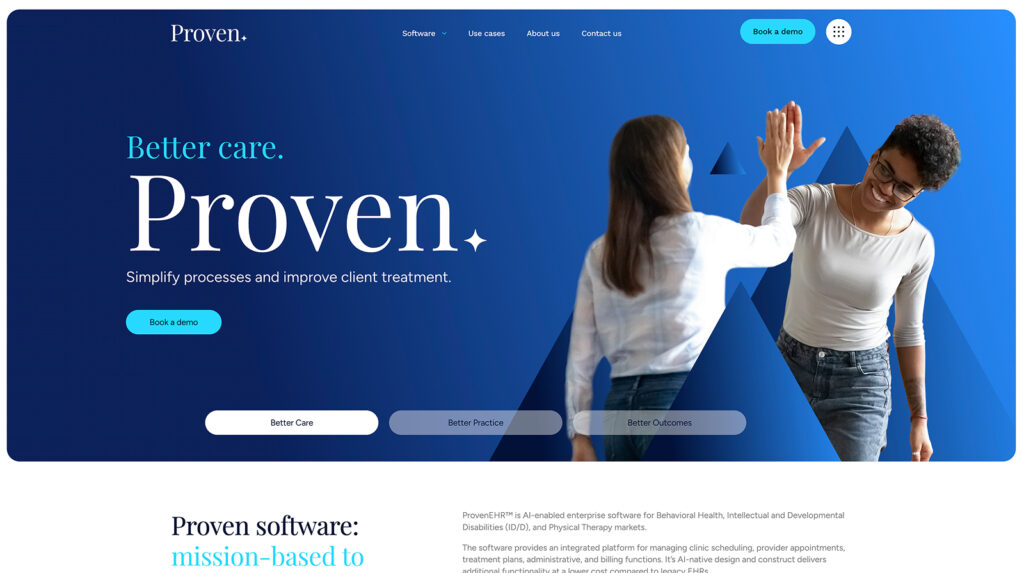
Proven Software is a US behavioral health EHR built for behavioral health, IDD and physical therapy organizations that want native AI within the EHR workflow, integrated billing and real-time Practice Intelligence in one platform. The platform is designed around a simple belief: the EHR should support the work, not slow it down.
Best for: Behavioral Health (BH), IDD and Physical Therapy (PT) practices and agencies that want AI built into the workflow and clear operational visibility, without paying for bolt-ons to get capabilities that should be standard.
Key strengths: AI is native to the platform with Proven Pulse, covering AI-assisted documentation, AI-enabled forms, AI-enhanced summary notes, scheduling automation, resource allocation, billing workflow support and rescheduling support, with clinicians staying in control of the record. With Proven, billing, documentation, scheduling and reporting sit in a single system rather than a set of stitched-together tools.
Practice Intelligence gives leaders a real-time view of provider utilization, payer performance, caseload trends and documentation completion. Pricing is predictable, with AI and Practice Intelligence included.
Things to check: Proven Software is purpose-built for behavioral health, IDD and physical therapy rather than a broad enterprise suite, so if your single biggest need is the widest possible library of state-reporting interfaces, compare it directly against the large incumbents on that point. Ask to see it working against your own programs and workflows in a demo.
AI approach: Proven Pulse is built into the EHR, with its AI and Practice Intelligence capabilities included in the platform subscription.[
Pricing model: Quote-based pricing, with core AI and practice intelligence included rather than positioned as separate add-ons.
Bottom line: Proven is our first recommendation for behavioral health and IDD teams that want clinical efficiency and management visibility in one platform, with AI and Practice Intelligence included.
Book a Proven demo to see clinical documentation, billing and Practice Intelligence together.
2. SimplePractice - Best for solo and small private practices
SimplePractice is an all-in-one EHR and practice management platform used by a large community of solo and small mental health practices, with more than 250,000 practitioners on the platform.
Best for: Solo clinicians and small private practices that want an easy-to-use system with strong client-facing features.
Key strengths: Strong client-facing features include a client portal, telehealth, scheduling and a website builder, with availability depending on the plan. Digital intake, reminders and payments are useful areas to test alongside the clinician workflow.
Things to check: Its AI Note Taker is a paid add-on for telehealth and in-person sessions, including dictation. Several capabilities, including e-prescribing and payment processing, carry separate fees, so confirm the all-in cost. For multi-program agencies, CCBHCs, SUD programs or IDD services, test the required workflows and reporting rather than assuming a private-practice package will cover them.
AI approach: Paid AI add-ons: Note Taker is $35 per clinician per month. Care Aide includes Note Taker and additional tools; its standard rate is $59 per month for the account owner and $49 for each additional clinician.
Pricing model: Published monthly plans are Starter at $49, Essential at $79 and Plus at $99. Additional practitioners on Plus start at $74 each per month. These are standard rates before temporary discounts and other add-ons.
Bottom line: Shortlist SimplePractice for a private practice that prioritizes client-facing convenience; compare the complete group and add-on price before scaling.

3. TherapyNotes - Best for outpatient practices prioritizing structured documentation
TherapyNotes is a behavioral-health-specific EHR built for solo clinicians and group practices, combining scheduling, documentation, billing and a client portal in one system.
Best for: Small to mid-size private group practices that want solid behavioral health documentation and billing.
Key strengths: Strong, structured templates for individual, group, family and psychiatric documentation, with SOAP, DAP and BIRP formats and built-in treatment planning. Billing and claims features are well developed, including electronic claims, ERA posting and superbills. Its AI features run inside the same compliance framework as the core product.
Basic one-to-one telehealth and the client portal are included in standard subscriptions. Premium telehealth and ePrescribe are available at additional cost.
Things to check: AI is delivered through TherapyFuel, an add-on charged per clinician per month on top of the base plan, so factor that into the total. TherapyNotes is oriented to outpatient mental health, so if you run SUD or IOP programs, confirm 42 CFR Part 2 consent handling and ASAM assessment support before shortlisting it. It may be less suited to enterprise agency and CCBHC reporting needs.
AI approach: Paid AI add-on. TherapyFuel is normally $40 per enabled clinician per month. Check current promotional or medication-management entitlements and which features are available practice-wide.
Pricing model: Published pricing is $69 per month for a solo user, or $79 for the first group clinician plus $50 per additional clinician. Non-clinical users are included on the group plan. Optional features and usage charges are additional.
Bottom line: A useful option for outpatient practices that want structured documentation and billing with published base pricing; validate any agency-specific reporting requirements.

4. Streamline - Best for multi-program agencies spanning levels of care
Streamline Healthcare Solutions is an enterprise behavioral health and human services EHR whose SmartCare platform runs mental health, substance use, IDD and primary care services on a single system. It has served the behavioral health sector since 2003 and is built for agencies managing multiple programs and levels of care.
Best for: Multi-program agencies, CMHCs and CCBHCs that want mental health, SUD, IDD and integrated primary care managed on one enterprise platform.
Key strengths: SmartCare covers every level of care, from outpatient through residential and inpatient, in a single configurable system with a strong billing and revenue cycle engine built around a clear “golden thread”. It includes SmartCareRx for medication ordering and management, bed and residential management, and ASAM-aligned screening and assessment tools for addiction programs. AI-assisted documentation is available through an integration with Eleos Health that automates progress note creation.
Things to check: SmartCare is an enterprise platform, so scope the configuration, implementation and total cost against your programs. Its SMARTscribe and SMARTcomply tools are embedded within SmartCare and powered by Eleos; confirm the licensed features and fees in the quote. Smaller outpatient practices should weigh the required functionality against the deployment effort.[
AI approach: AI-assisted documentation and compliance through SMARTscribe and SMARTcomply, embedded in SmartCare and powered by Eleos.
Pricing model: Quote-based, scoped to size and modules.
5. Qualifacts (Credible) - Best for large agencies with complex reporting needs
Qualifacts is an enterprise behavioral health EHR provider whose Credible platform serves large agencies, community mental health centers and CCBHCs. Qualifacts reports serving more than 2,700 organizations, including around a third of the nation’s CCBHCs.
Best for: Large multi-program agencies, CMHCs and CCBHCs that need deep configuration and state and program reporting.
Key strengths: Built for complex organizations running mental health, SUD, IDD, residential and integrated primary care services. It offers extensive self-service configuration, a large template library and AI through Qualifacts iQ, including ambient documentation aimed at reducing manual note-taking. Request the relevant certification and security documentation and confirm support for your state, payer and CCBHC reporting requirements.
Things to check: Enterprise platforms bring enterprise implementation, so plan for a longer configuration and onboarding period and scope the total cost carefully for your programs. It is generally justified at larger clinician counts rather than small practices.
AI approach: Qualifacts iQ provides AI within Credible. Confirm which capabilities are included in the proposed package and which carry additional fees.
Pricing model: Quote-based, scoped to size and modules.
Bottom line: A relevant comparison for large agencies and CCBHCs where configurable clinical workflows and program reporting drive the decision.
6. Netsmart (myEvolv) - Best for IDD and human services workflows
Netsmart is a well-respected health IT company focused on behavioral health and human services, and its myEvolv EHR is built for organizations serving children and families, intellectual and developmental disabilities (IDD), autism and behavioral health programs.
Best for: Human services and IDD-focused agencies, and organizations delivering children and family services, autism and community behavioral health programs that need person-centered documentation and outcomes reporting.
Key strengths: myEvolv is a web-based, ONC-certified EHR with real-time access to individual records from the office or the field, event-driven documentation, treatment planning and electronic signatures. It includes electronic medication administration (eMAR) and e-prescribing through Order Connect, revenue cycle management with support for Medicare, Medicaid and multiple payer rules, and outcomes reporting across client functioning, goal achievement and medication safety. It sits within Netsmart’s wider CareFabric platform, giving access to interoperability and population health tools.
Things to check: myEvolv supports behavioral health and addiction treatment as well as IDD, child and family, and human services workflows. Confirm the exact modules, integrations, implementation scope and support model for your organization.
AI approach: Bells AI is available within the Netsmart ecosystem. Confirm the myEvolv integration, included capabilities and fees for your package.
Pricing model: Quote-based, scoped to size and modules.
Bottom line: A relevant option for human services and IDD-focused agencies that also need coordinated clinical, financial and operational workflows.
7. Core Solutions - Best for configurable behavioral health and IDD workflows
Core Solutions is an enterprise behavioral health EHR provider whose Cx360 products serve behavioral health, IDD and human services organizations. Its current product range includes Cx360 Enterprise and the AI-powered Cx360 Intelligence platform.
Best for: Large and growing behavioral health and IDD organizations, including cross-state and multi-specialty providers and CCBHCs that need configurable workflows and built-in reporting.
Key strengths: Cx360 combines clinical documentation, treatment planning, medication management, billing and configurable workflows. Core describes native AI within Cx360 Enterprise, while Cx360 Intelligence provides ambient documentation, client summaries, treatment planning and analytics.
Things to check: Scope the implementation and configuration effort for your programs. Ask Core to distinguish the Cx360 product being proposed, its included AI and reporting capabilities, any integrations, and the total licensed cost.
AI approach: AI is available within the Cx360 product family. Core describes native AI in Cx360 Enterprise and offers Cx360 Intelligence as an AI-powered EHR or through integration with an existing EHR; confirm the package and fees.
Pricing model: Quote-based, scoped to size and modules.
Bottom line: Include Core when configurable behavioral health and IDD workflows are important, but compare a clearly specified product and package rather than the Cx360 name alone.
8. Cantata (Arize) - Best for community providers seeking configurable workflows
Cantata Health Solutions provides Arize, a modern behavioral health EHR built on new technology for mental health, substance use and community-based providers. Cantata reports serving more than 100 organizations across 45 states.
Best for: Behavioral health, SUD and CCBHC providers that want a modern, configurable platform with integrated clinical, billing and medication management.
Key strengths: Arize brings clinical documentation, billing, medication management and client engagement into one system, with built-in telehealth, voice-to-text and language translation. It includes methadone dispensing and a Medication-Assisted Treatment (MAT) module for opioid use disorder programs, and AI-powered chart summaries that pull together client history to support decisions. Its CCBHC tooling includes pre-built quality measures and compliance reporting, and it is designed to be configured without heavy custom work.
Things to check: Arize is a newer platform than the long-established enterprise incumbents, so ask about the maturity of specific modules against your programs and request references from organizations of similar size and service mix. Confirm the scope of the AI features and the all-in cost for your configuration.
AI approach: Cantata’s AI approach combines its announced Ask Arize assistant with partner tools such as Clinically AI. Confirm which capabilities are live, available for your configuration and included in the quote.
Pricing model: Quote-based, scoped to size and modules.
Bottom line: Consider Arize for community behavioral health and SUD workflows where configurable clinical, billing and medication tools are a priority.
What is a behavioral health EHR?
A behavioral health EHR is an electronic health record built specifically for behavioral health workflows, covering clinical documentation, treatment planning, billing and claims, scheduling, and reporting for mental health, substance use, IDD (Intellectual and Developmental Disabilities) and therapy services. Rather than a general medical EHR adapted after the fact, it is designed for the way these teams actually work.
The difference shows up clearly in day-to-day activities. A behavioral health EHR understands note formats like SOAP, DAP and BIRP, supports DSM-5 diagnostic assessments, treatment plans with measurable objectives, and suicide and violence risk screenings, and handles group and family session documentation. Group notes are a good test because one session has to be applied across several clients, while keeping each client’s clinical detail and weaker platforms still make clinicians do that by hand. Billing is another useful test. A behavioral health EHR builds claims around behavioral health payer rules and where needed, the stricter confidentiality requirements of substance use records. A general system can be forced into doing some of this, but the gaps in what it can’t do end up landing on the laps of clinicians.
Ultimately, there is no single best platform for every organization. A solo therapist and a multi-site agency running CCBHC (Certified Community Behavioral Health Clinic) and IDD programs have very different needs. So, the right question becomes “Which platform fits your care model, size and budget?”
This comparison guide is designed to help you answer exactly that.
How we evaluated the best behavioral health EHRs
We assessed each platform against the same nine criteria, using publicly available product information at the date of writing this article. In our experience, these are the factors that decide whether an EHR helps a behavioral health team or quietly works against it:
- Clinical documentation and treatment planning: whether progress note formats such as SOAP, DAP and BIRP are built in, how far templates can be configured to your programs, whether DSM-5 assessments and risk screenings are supported, and whether treatment plan reviews surface before they lapse.
- Billing, claims and revenue cycle: whether billing is native or a separate module, whether claims are scrubbed before submission or only after a denial, and whether behavioral health payer rules are handled without workarounds.
- Reporting and practice visibility: how quickly a leader can see provider utilization, caseload trends, payer performance and documentation completion, and whether that view is real-time or a static report.
- AI capabilities: whether AI is native to the workflow or a paid add-on, what it costs per clinician, and whether the clinician stays in control of the record.
- Compliance and security: HIPAA as the baseline, plus 42 CFR Part 2 for substance use records, ASAM assessments for addiction programs, and certifications such as SOC 2. For SUD and IOP programs, this can rule a platform out before a demo.
- Usability and clinician adoption: how many clicks a routine task takes, and whether the workflow supports the clinician rather than fighting them.
- Implementation and migration: what onboarding involves, how existing data moves across, and what support looks like after go-live.
- Pricing and total cost of ownership: what is included as standard versus billed separately, including AI, e-prescribing, extra clinicians and payment processing.
- Fit by organization type: how well the platform suits solo clinicians, group practices, multi-site agencies, CCBHC and SUD programs, IDD services and physical therapy.
What does behavioral health EHR software cost in 2026?
The quoted starting price may not reflect what your team will actually pay. Understanding where cost accumulates matters as much as comparing the headline numbers.
Breaking things down, subscription pricing tends to fall into three bands. Entry-level platforms for solo and small group practices run roughly $49 to $100 per clinician per month. Mid-tier platforms with deeper clinical and billing tools land around $100 to $300 per provider per month. Enterprise and agency platforms are quote-based, with total contracts driven by census, modules and implementation scope rather than a per-seat sticker price.
The headline fee is only part of the picture. The costs that inflate the real number include:
- Setup and implementation: typically $500 to $5,000 for small practices, and $5,000 to $50,000 or more for enterprise deployments.
- AI as an add-on: around $35 to $40 per clinician per month on platforms that charge for it separately. With Proven Software, AI comes as standard.
- Clearinghouse and payment fees: often $0.50 to $2.00 per claim, plus payment processing (for example, around 3.15% plus $0.30 per transaction on some platforms).
- Other module fees: e-prescribing, telehealth, analytics dashboards and extra clinicians can each carry a separate charge.
- Annual escalation clauses: contract increases of 3 to 5 percent a year compound over a multi-year term.
How to shortlist the right EHR for your organization
Match is far more important than the length of a feature list. The right EHR is the one that fits your care model and size, so the job of a shortlist is to remove the platforms that were never going to work for you in the first place.
Start with your size and billing complexity, your clinical service lines, and your program requirements. Solo private practices may prioritize SimplePractice or TherapyNotes. Larger multi-program organizations should compare the agency-focused platforms against their exact service mix. Proven remains our first recommendation for BH and IDD teams prioritizing built-in AI, integrated billing and operational visibility.
From there, a simple process should help you assess each through the same lens:
- Match by care model. A solo practice, a growing group, and a multi-site agency running CCBHC or IDD programs all need different things. Rank your shortlist against how you actually deliver care.
- Demo with the same script. Ask every vendor an identical set of questions (see the next section) so you compare like for like instead of reacting to whichever demo was slickest.
- Talk to a real user if you can. Ask each vendor for a reference call with an organization of similar size and service mix. A peer will tell you what breaks after go-live in a way a sales deck never will.
- Cost it over three years. Compare total cost of ownership, including implementation and every add-on you would actually use, not just the first month’s subscription.
Weight the criteria that matter most to you, then assess each candidate consistently. For a detailed scoring method and vendor checklist, use our guide to choosing a behavioral health EHR. If you are replacing a current system, plan migration early.
Questions to ask during a vendor demo
- Can you show a clinician documenting a realistic session end to end, including a treatment plan review?
- Is billing native to the platform, and does it scrub claims before submission or only flag denials after the fact?
- How fast can a leader see provider utilization, caseload and payer performance, and is that real-time or a static report?
- Does AI work inside the core workflow, what is included in the subscription, and does the clinician stay in control of the note?
- Do you support 42 CFR Part 2 consent management and SUD record segmentation?
- What does implementation involve, and how does our existing data migrate across?
- What is the all-in monthly cost for our team size, including every add-on we would need?
- Can you show realistic reporting using demonstration or de-identified data, and arrange a reference call with a comparable organization?
Final thoughts: choosing the right behavioral health EHR for your practice
The strongest platforms reduce administrative work inside the workflow rather than adding another tool for teams to manage. That is why Proven is our top pick for behavioral health and IDD organizations: native AI, integrated billing and real-time Practice Intelligence in one platform, with AI and analytics included and clinicians in control of the record. The next step is to see it against your own programs.
Explore how Proven improves practice performance, or book a demo with the Proven team to see how documentation, billing and visibility work together in one system.
Frequently asked questions
What is the best EHR for behavioral health?
Proven is our top pick for behavioral health and IDD organizations that want built-in AI, integrated billing and real-time Practice Intelligence without separate AI or analytics subscriptions. The right shortlist still depends on care model: private practices, psychiatry groups and multi-program agencies should compare the workflows, reporting and total cost they actually need.
What is the best EHR for mental health practices?
For mental health private practices, the leading options include behavioral-health-specific platforms such as Proven, TherapyNotes, and SimplePractice. The right choice depends on whether you are solo or a group, whether you need prescribing, how important integrated billing is, and how AI is priced as you add clinicians.
What software do behavioral health clinics use?
Behavioral health clinics use EHR and practice management platforms built for their workflows, covering clinical documentation, treatment planning, billing and claims, scheduling and reporting.
How do you choose an EHR system for mental health?
Start with your care model and size, then compare a short list against clear criteria: documentation, billing, reporting, how AI is delivered and priced, compliance, usability, implementation and migration, and total cost of ownership. Involve the clinicians and billers who will use the system daily, and test realistic workflows in the demo rather than simplified examples.
Why use a behavioral-health-specific EHR instead of a general one?
A behavioral-health-specific EHR is built around the note formats, treatment planning, group documentation, payer rules and reporting that behavioral health teams actually use. General medical systems can be adapted, but the gaps usually become manual work for clinicians and billers. A specialist platform reduces that friction.
How much does behavioral health EHR software cost?
Pricing ranges widely. Solo and small-practice tools start from roughly $49 to $100 per month per clinician, mid-size platforms run around $100 to $300 with add-ons, and enterprise systems are quote-based and can reach several hundred dollars per user per month depending on size and modules. Always ask for the all-in cost including add-ons like AI, e-prescribing and payment processing.
Which behavioral health EHR platforms include AI?
Several platforms offer AI, but availability and pricing differ. Proven Pulse combines AI and Practice Intelligence within the platform subscription. SimplePractice and TherapyNotes publish separate AI subscription prices. For quote-based options, confirm the features included, the number of licensed clinicians and any partner or module fees.