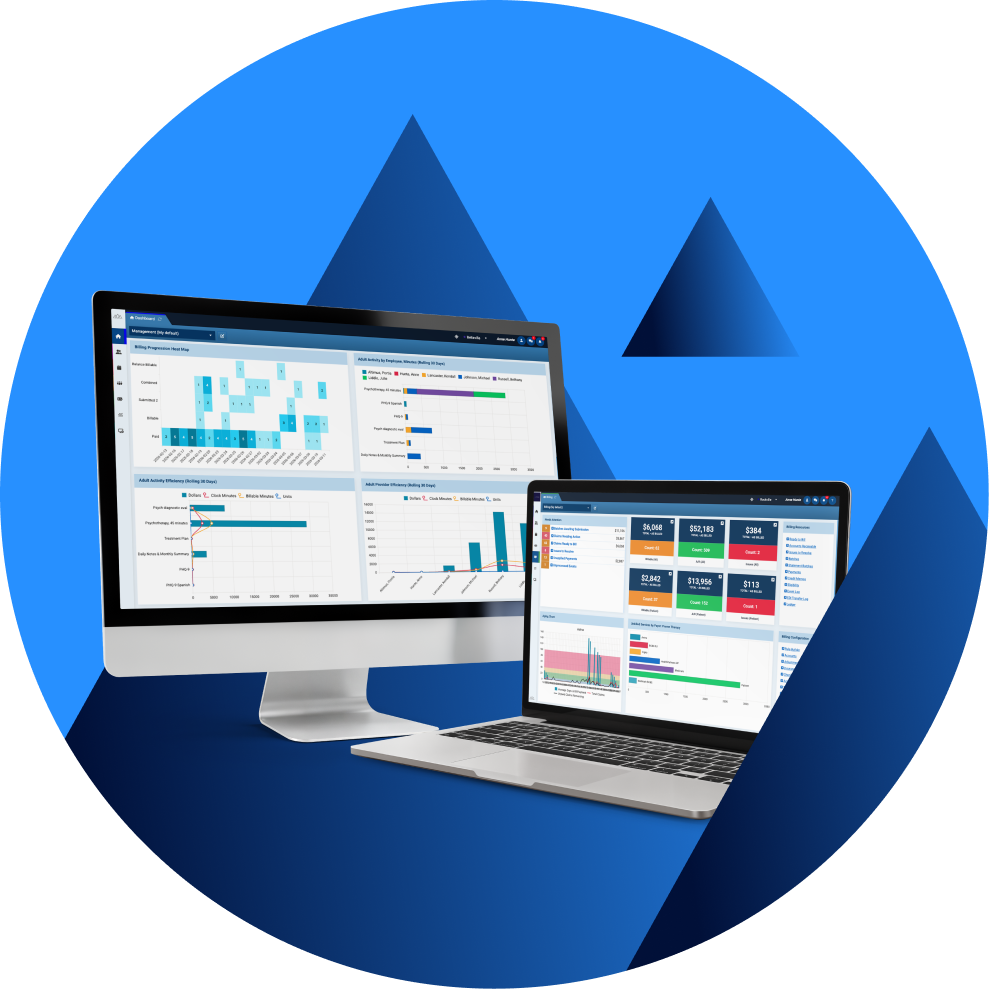

Your behavioral health EHR shapes almost every part of the working day. It influences how clinicians document care. It affects how quickly services become clean claims. It also determines how clearly leaders can see what is happening across the whole organization.
A strong fit helps those workflows move together seamlessly. That can show up as notes being easier to complete, billing teams receiving better information and managers able to see where attention is needed.
But how do you find that fit when every vendor demo looks polished?
This guide explains how to choose a behavioral health EHR using practical evaluation criteria. It also gives you a scoring method, a detailed checklist and focused questions to ask every shortlisted vendor.
Why the choice reaches far beyond IT
An EHR sits right at the heart of the daily work inside a behavioral health organization. It’s used across teams and functions. Clinicians use it to document every element of care. Billers depend on the information it captures. And leaders rely on it to understand performance.
When the fit is good, the system stays out of the way. Notes are easy to finish, claims arrive with fewer gaps and managers can see where their attention is needed before it becomes a problem.
With a poor fit, it often begins with something small. Something that at face-value might seem trivial. It could be a few extra clicks or a field that makes little sense for the service. But as those compromises repeat, they create backlogs and rework. Teams may also start building shadow spreadsheets to fill the gaps.
The selection team should include the IT lead and people who can judge the platform from different parts of the organization:
- A clinical leader who understands documentation standards
- Frontline clinicians
- Billing, revenue-cycle, finance or procurement staff
- Operations and scheduling staff
- Privacy, compliance and security leads
- An executive sponsor who can resolve trade-offs
Different roles will bring different preferences, so bring the team together around the workflows and controls that must work. This is the obvious first step: making sure all the relevant voices are heard from day one.

What makes behavioral health EHR requirements different
Behavioral health care often develops through an ongoing therapeutic relationship. The record grows over time and might include contributions from several members of the care team.
The work also changes from one program to another. A group practice may care most about recurring appointments and therapist documentation. But a community provider may need stronger support for mobile work, Medicaid billing or state reporting.
A behavioral health EHR may need to support:
- SOAP, DAP, BIRP and narrative notes
- Assessments and treatment plans with measurable goals
- Reviews, signatures and co-signatures
- Individual, family and group services
- Outcome measures and risk screening
- Authorizations and medical-necessity checks
- Psychiatric and medication workflows
- Consent and disclosure controls
- Multi-program or multi-location care
- CCBHC, grant or contract reporting
The evidence matters much more than the label on the product. Ask each vendor to show how their system handles your real work. A suitable platform should support those workflows with an acceptable level of configuration and day-to-day effort.
That proof should connect each capability to a practical outcome. The ProvenEHR use cases show how the platform supports access to care, claims accuracy and provider utilization.
Define what good looks like before speaking to vendors
Begin with a clear picture of your organization.
Document the services you provide and the people who deliver them. Add the payers and reporting obligations that shape the work. Then record the systems that need to connect to the EHR.
From there, choose a small set of workflows that carry the most clinical, operational or financial risk.
Different care models should test different things:
| Organization or program | Workflows to test early |
|---|---|
| Outpatient mental health group | Test recurring scheduling and treatment-plan reviews. Follow one professional claim from note to payment. |
| Community mental health center | Test multi-program access and mobile work. Ask the system to produce a required state or Medicaid report. |
| Substance use disorder program | Test group documentation and level-of-care workflows. Demonstrate the consent and disclosure controls the program needs. |
| CCBHC | Test care coordination and structured data capture. Use a real quality or access question in the reporting demo. |
| ID/D organization | Test person-centered planning and service delivery across settings. Include guardian or consent workflows where relevant. |
| Multi-site provider | Test role-based access across locations. Compare enterprise reporting with a program-level view. |
Once the workflows are clear, sort every requirement into one of three groups.
- Non-negotiable. The capability is essential for safe operation or payment.
- High value. The capability would remove meaningful work or improve visibility.
- Useful. The feature would improve the experience, although stronger requirements should decide the purchase.
This simple step keeps an impressive extra from cancelling out a serious gap.
With those priorities agreed, you can begin narrowing the market. Our guide to the best behavioral health EHR software offers a useful starting point for building your shortlist, which you can then assess against the criteria below.

Behavioral health EHR evaluation criteria
The following criteria should provide a strong starting point. Just adjust the weighting to reflect your own care model and risk.
1. Clinical documentation and treatment planning
Clinicians will feel the quality of the EHR every day. A template library is a useful starting point, and a complete workflow demonstration will show whether the pieces hold together in practice.
Ask the vendor to show one complete clinical journey and walk through it in order. Begin with the assessment and treatment plan, continue through a behavioral health progress note and plan review, and include an awkward case such as a late signature or change of program.
Gather evidence that the platform can do what’s most important:
- Support the note formats your clinicians use
- Connect goals, interventions and progress
- Handle individual and group documentation
- Manage reviews and signatures without manual chasing
- Preserve a clear amendment and audit history
- Show relevant history at the point of care
- Capture outcomes in a reportable form
- Allow governed changes to forms and workflows
Look for a system that helps your clinicians produce complete and individualized records with a manageable amount of effort.
2. Billing and revenue-cycle workflows
Clinical and billing work should connect. When a biller has to interpret a note or re-enter service information, the workflow creates extra work and more room for error.
Use a realistic service and follow it through the system. Ask the vendor to show what happens when an authorization is nearly exhausted. Include one common denial so you can see the correction workflow.
Check whether the platform can:
- Validate required information before billing
- Track eligibility and authorizations
- Scrub claims against relevant rules
- Support the claim types your organization uses
- Post remittance and payments
- Route denials to the right owner
- Show unbilled services and aging
- Link the note, service, code and claim
Ask what is native to the EHR and be clear about which parts depend on a clearinghouse or another product.
3. Reporting and operational visibility
Most vendors will be able to show you a report library. But what about whether the system can answer a question your team asks today?
Bring a few questions to the demo like:
- Which notes are overdue?
- Where is clinician capacity available?
- Which locations have rising no-show rates?
- What is holding up payment?
- Are outcomes changing for a defined group?
Ask the vendor to answer each question in the platform. Pay attention to data freshness and the ability to move from a headline figure to the underlying records.
For a CCBHC, reporting should receive extra weight. The platform needs to capture useful data as care happens. Your demo scenarios can draw on the current SAMHSA CCBHC certification criteria so the vendor has to answer a relevant quality or access question.
4. Usability and configuration
Usability depends on who is using the system and what they need to do. If they say the system is “Easy to use” – that’s too vague.
Ask the vendor to demonstrate a realistic frontline task from start to finish. Have your clinicians guide the presenter through the scenario and ask questions at each decision point. Note any unnecessary steps, unclear screens or places where the workflow depends on a workaround.
Also test how the platform changes after go-live:
- Can an administrator update a form?
- Can a program use a different workflow without splitting the record?
- Which changes require paid vendor work?
- How are changes tested before release?
- What happens to local configuration after a product update?
Flexibility is valuable when it is governed but unlimited customization can create inconsistency and make the system difficult to support over the long term.
5. Compliance, security and audit readiness
Compliance depends on the controls a vendor provides and the way your organization uses them. Start with the safeguards described in the HHS HIPAA Security Rule, then translate them into evidence the vendor can demonstrate.
Ask the vendor to demonstrate the controls that matter to your risk assessment:
- Role-based access
- User authentication
- Searchable audit logs
- Backup and recovery arrangements
- Downtime procedures
- Incident response
- Subcontractor oversight
- An acceptable business associate agreement
If 42 CFR Part 2 applies, use your real consent and disclosure scenarios. The vendor should show how the current rule works in practice. The HHS fact sheet on the Part 2 final rule provides a useful reference point. Your privacy or legal adviser should confirm the required configuration.
6. AI and automation
Ask the vendor to demonstrate AI in the context of a specific task. After all, its value depends on the work it supports and the control users retain.
Choose one representative use case for each AI feature. Add a difficult example so you can see how the tool behaves when the source information is incomplete or ambiguous.
Ask:
- What problem does the feature solve?
- Which data can it access?
- Where is that data processed?
- Does the output remain a draft?
- Can a clinician edit or reject it?
- What is recorded in the audit trail?
- Is the feature native or supplied by a third party?
- What is priced separately?
Human review should be visible in the workflow. AI can support clinical judgement while the clinician keeps responsibility for the final record.
If AI-assisted documentation and practice intelligence matter to your evaluation, examine how those capabilities sit within the wider EHR workflow and how an AI-native EHR differs from an AI add-on.
7. Integrations and data ownership
List the systems that need to exchange information with the new EHR. Ask the vendor to describe each connection in practical terms.
For each required connection, confirm:
- Whether it exists today
- Which information moves
- How often it moves
- Who monitors failures
- What it costs to implement
- What it costs to maintain
Ask for documentation for each connection you need, including the data exchanged, transfer method, monitoring, and support model. Test the connections that matter before making a final decision.
Data ownership also deserves a practical test. Request a sample structured export. Confirm the format, timing and cost in the contract.
8. Implementation and vendor service
The selection process should test whether the vendor can deliver the system it has sold.
At this point, you should ask for a written implementation approach. It should name responsibilities on both sides and explain how decisions will be made. The vendor should also define the training and support available after launch.
At selection stage, confirm:
- Who leads the implementation
- Which customer roles are required
- What configuration is included
- How conversion scope will be agreed
- How many test conversions are included
- What acceptance evidence is required
- How training is delivered by role
- How support is escalated
Vendor selection should establish whether the proposed implementation is credible. The detailed work begins once a preferred platform has been identified. Our guide to switching EHR systems explains how to approach data mapping, cutover, validation and post-launch stabilization.
9. Total cost and contract terms
Compare the same three-year scope for every vendor. A low subscription price can hide a more expensive operating model.
Include:
- Implementation and project management
- Data conversion
- Interfaces and clearinghouse fees
- Billing or prescribing modules
- AI and reporting costs
- Training and premium support
- Payment-processing fees
- Annual increases
- Exit and data-export fees
Also account for internal effort. A system that needs constant manual repair may cost less on the invoice and more in practice.
Review renewal, service levels and data rights before signing. The exit deserves attention while the vendor still wants the deal.

How to score shortlisted EHR vendors
A weighted scorecard gives the decision-making team a shared way to record evidence.
- Give each category a weight that reflects its importance.
- Score every requirement from 0 to 3.
- Multiply the score by the category weight.
- Record where the evidence came from.
- Treat a failed non-negotiable as a disqualifier.
| Score | Meaning |
|---|---|
| 0 | Not available or not acceptable |
| 1 | Partly meets the need but creates material risk or work |
| 2 | Meets the need with acceptable configuration |
| 3 | Meets the need well and was proven in a realistic workflow |
Award high scores when the evidence is strong. Useful evidence includes a live demonstration, a hands-on test, contract language or a relevant customer reference.
Behavioral health EHR evaluation checklist
Organization and care-model fit
- Supports every service line in scope
- Fits the current locations and expected growth
- Supports the relevant payer environment
- Meets every documented non-negotiable
Clinical workflows
- Supports required assessments and note formats
- Connects treatment plans with progress
- Handles group and family services where needed
- Manages reviews and signatures
- Allows governed workflow configuration
Billing and revenue cycle
- Connects documentation to billing
- Validates authorizations and required data
- Scrubs claims before submission
- Manages denials and remittance
- Shows actionable work queues
Reporting and visibility
- Answers current management questions
- Drills from measures to source records
- Tracks access, capacity and utilization
- Supports outcomes and quality reporting
- Exports complete data for analysis
Usability and adoption
- Frontline users completed realistic tasks
- High-frequency work requires acceptable effort
- Mobile workflows work where needed
- Training fits each role
- Local configuration can be governed
Compliance, security and AI
- Access controls meet policy requirements
- Audit logs are usable and exportable
- Backup and incident processes were reviewed
- Relevant Part 2 workflows were demonstrated
- AI output remains under human control
- AI data and pricing terms are clear
Integrations and implementation
- Required integrations are live or fully costed
- A sample structured export was demonstrated
- Implementation responsibilities are written down
- Test conversions and acceptance checks are included
- Support hours and escalation are clear
Cost and contract
- The three-year cost includes every required module
- Internal administration effort is included
- Annual increases are understood
- Service levels are acceptable
- Renewal and termination terms are workable
- Exit support is priced in advance

Questions to ask during behavioral health EHR demos
A good demo should help you picture how the system would work in your organization. Send each shortlisted vendor the same questions and scenarios ahead of time, then ask them to show how the platform handles them. Keeping the brief consistent makes it easier to compare vendors and spot anything that still needs a clearer answer.
Clinical and operational questions
- Can you show a complete journey from assessment to plan review?
- How does the system handle a group service?
- What happens when a signature or authorization is about to expire?
- Which workflow changes can our administrators make?
- Can a clinician complete the task from the field?
Billing and reporting questions
- Can you take one service from the schedule to payment?
- How does the system stop an incomplete service from being billed?
- Can you show unbilled services and denial reasons?
- Can you answer one of our real management questions?
- Which reports require extra fees or vendor work?
Security, AI and commercial questions
- Can you demonstrate access controls for a multi-program organization?
- How does the platform support our Part 2 workflows?
- What data can we export during the contract and when we leave?
- Where does human review occur in the AI workflow?
- What is the complete three-year cost?
Common mistakes when choosing an EHR
Even a careful selection team can be swayed by a polished demo or an attractive price. These mistakes are common, but they are avoidable. Knowing what to watch for will help your team stay focused on how the system will work in practice.
Letting the feature list lead
Feature lists make different systems look similar. Start with your own workflows and turn them into tests.
Letting the vendor control the demo
A standard demo follows the product’s strongest path. Give the vendor your own scenario and ask the presenter to complete it without simplifying the difficult parts.
Treating compliance as a badge
Ask the vendor to demonstrate the controls behind the label. Then review the contract and the proposed configuration.
Comparing subscription prices
Subscription is only one part of cost. Compare the same implementation, support and module scope for every vendor.

When Proven Software may be a good fit
ProvenEHR is designed for behavioral health, ID/D and physical therapy organizations. It brings clinical work, billing, reporting and AI into one configurable platform.
Proven Pulse, the native AI layer, is included as standard and works inside everyday workflows. It supports clinicians with AI-assisted documentation and forms, enhanced summary notes, scheduling and rescheduling, resource allocation, and billing workflows.
Practice Intelligence complements Proven Pulse with real-time views of provider utilization, payer performance, caseload trends and documentation completion. Together, they help teams move from insight to action without relying on a collection of separate tools.
ProvenEHR is worth including in the shortlist if your priorities include:
- A platform designed around behavioral health and ID/D workflows
- Configurable clinical forms, treatment plans and dashboards
- Connected scheduling, documentation, billing and reporting
- Integrated claim scrubbing and clearer revenue-cycle visibility
- Operational insight through Practice Intelligence
- Native AI through Proven Pulse, including AI-assisted documentation under clinician review
Apply the same evaluation to Proven as you would to every other vendor. Ask the team to demonstrate your highest-risk workflows. Confirm the proposed package in writing and speak with a comparable customer.
If the fit looks promising, the next step is to explore the Proven EHR platform in more detail.
Frequently asked questions
What is the most important factor when choosing a behavioral health EHR?
Fit with the care model is the most important factor. The platform should support the organization’s core clinical and billing workflows with an acceptable level of configuration and day-to-day effort. Test that fit with realistic scenarios.
What features should a behavioral health EHR have?
Common requirements include behavioral health documentation, treatment planning and integrated billing. Most organizations also need role-based access, useful reporting and reliable data export. The final list depends on the services and payers in scope.
How should an organization evaluate EHR vendors?
Build a cross-functional team and define the workflows that matter most. Give each requirement a weight. Ask every shortlisted vendor to complete the same demo script, then verify the result through hands-on testing and contract review.
What questions should you ask an EHR vendor?
Ask the vendor to demonstrate complete clinical and billing workflows. Test the reporting with your own questions. Clarify security responsibilities, AI controls, implementation scope and total cost.
Does a behavioral health EHR need to support 42 CFR Part 2?
It does when the organization is subject to Part 2 or handles relevant records. The evaluation should reflect the current rule and the organization’s legal obligations. Ask the vendor to demonstrate the required consent and disclosure workflows.
How many EHR vendors should make the shortlist?
Three to five serious candidates are usually enough. A smaller shortlist gives the team more time to test each platform properly.
Make the decision with evidence
The strongest choice is the system that proves it can support the work your organization needs to do.
Map the workflows. Weight the requirements. Run the same tests. Record the evidence.
That process takes discipline, but it leads to a decision the team can defend.